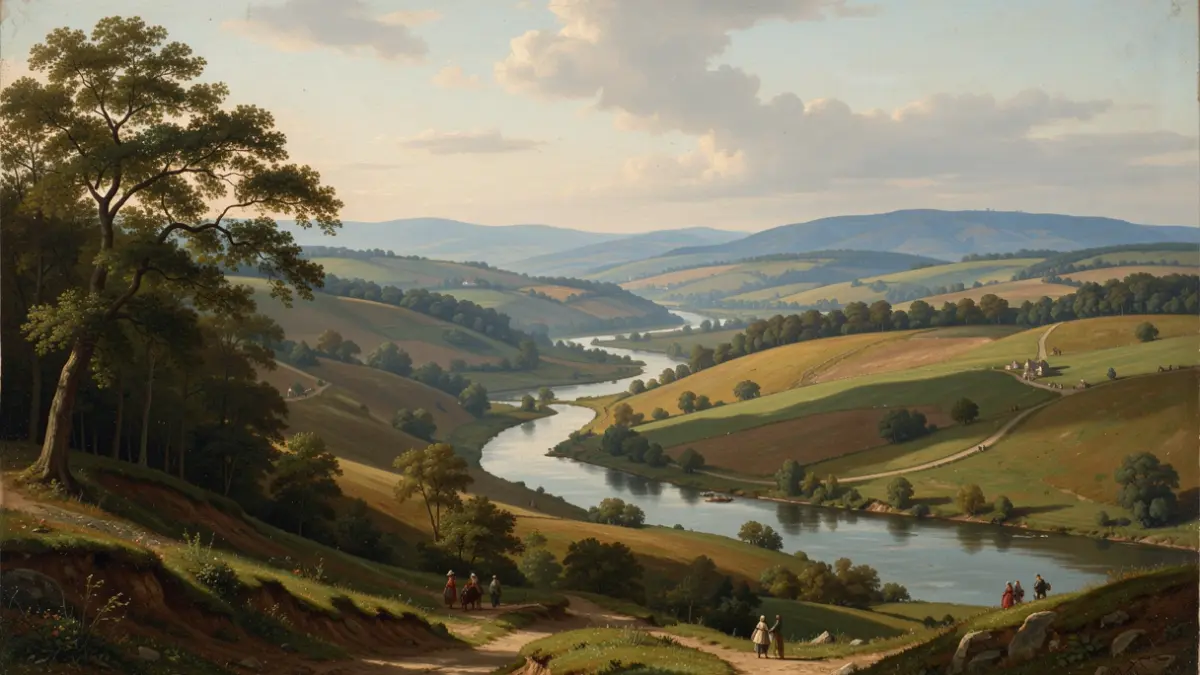
Research has connected this artwork to a painting with an identical composition at the National Museum in Warsaw and a similar piece from the Royal Museums of Fine Arts of Belgium in Brussels. The latter, titled Le départ pour le marché, is signed LVV and attributed to Lucas van Uden, with figures attributed to David II Teniers. These comparisons suggest an attribution of the Jehay painting to the workshop or circle of Lucas van Uden.
Born in Antwerp in the late 16th century, Lucas van Uden, son of painter Artus van Uden, specialized in landscape painting. Influenced by Peter Paul Rubens, he is known for his open, studio-recomposed landscapes, often not depicting specific locations. The Jehay painting shares several of his characteristics: a wooded mass on the left, a path with figures, a valley with meadows and dwellings, and bluish hills, creating a sense of depth through layered planes.
This approach aligns with the Flemish tradition of artists like Pieter Bruegel the Elder, Joos de Momper, and Jan Brueghel the Elder, where landscape became a subject in its own right in the 17th century, gaining significant commercial success among private collectors.
The compositional and dimensional similarities (24 × 34.5 cm for Jehay, 25.5 × 37.5 cm for Warsaw) between the Jehay and Warsaw paintings suggest the use of a common model. The Brussels version, larger at 95 × 127 cm, features a similar landscape but with variations in the decor and foreground figures.
These resemblances and variations illustrate the practices of 17th-century Flemish workshops, where the repetition of popular compositions, sometimes with modifications, met commercial demand. Figure painting could be entrusted to specialists like David II Teniers, a documented collaborator of Lucas van Uden, thereby increasing the works' commercial value.
While attribution to the circle of Lucas van Uden is favored due to the lack of further technical or documentary evidence, this painting highlights the success of Flemish landscapes in the 17th century and the collaborative practices of the era. The artwork can be viewed on commoncollections.be.