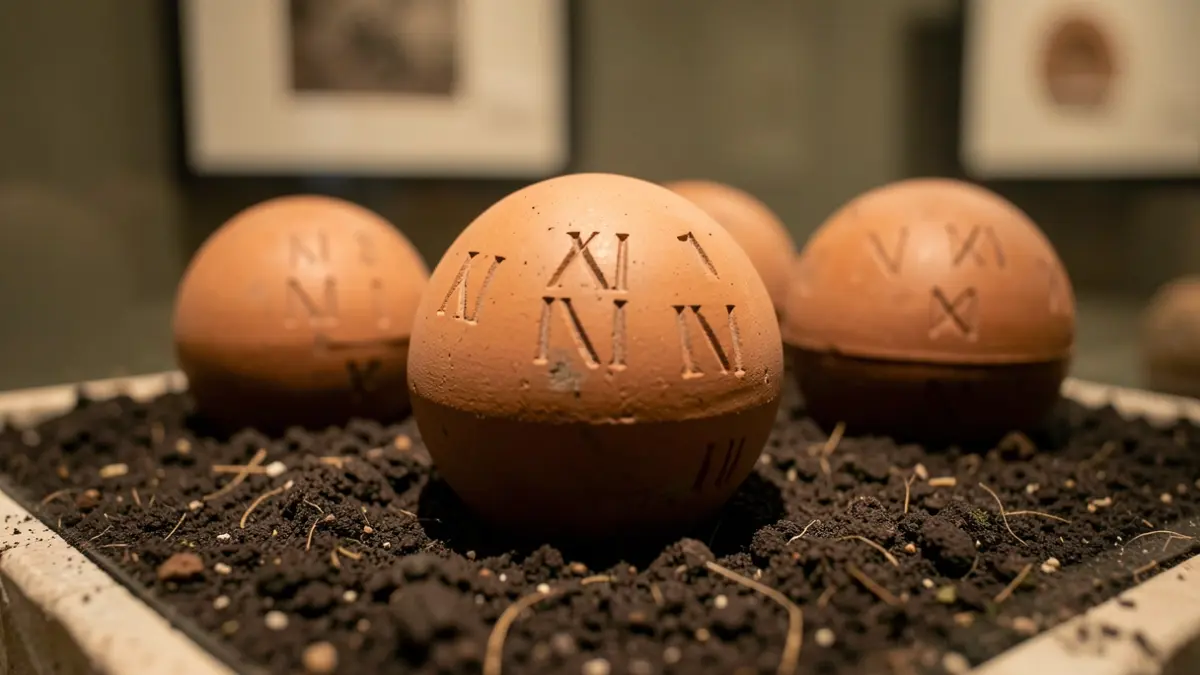
Between 1903 and 1906, excavations led by schoolmaster Firmin Hénaux at the site of a Roman villa in Vervoz (Clavier, Liège) unearthed an unusual collection of 22 terracotta balls. These objects, dating from the late 1st or early 2nd century AD, bear Roman numerals incised before firing.
The balls, with diameters ranging from 1.4 to 2.1 cm, are marked with the following Roman numerals: I (three times), XIII, XVII, XX, XXX, XXXVII, XXXVIII, XXXXI (twice), LX, LXV, LXVI, LXVII, LXXX, LXXXIII, LXXXIIII, LXXXVI (twice), LXXXXV, and LXXXXVI. Their weight varies between 3.09 and 10.66 g. These artifacts are considered unique in Belgium.
Similar discoveries have been made in Treveran territory, notably at the Martberg oppidum near Pommern in Germany, where 27 numbered balls were found, as well as in Karden and Nida-Heddernheim. These findings suggest the existence of three distinct sets of balls ranging from I to CI.
Several hypotheses have been proposed to explain the function of these numbered spheres, including a form of oracular lottery, accessories for lot-drawing for electoral purposes, or for selecting members of the Ordo decurionum.
These archaeological objects are currently on display in the 'object of the month' showcase in the entrance hall of the Grand Curtius museum in Liège.